Vertigo: Hitchcock’s Obsessive Masterpiece
© Paramount Pictures
Continuing our series on the Sight and Sound Poll, let’s look at the 2nd Greatest Movie Ever.
The theme of Obsession is zeitgeisty in the year 2026. We just had the successful horror film Obsession dominate discourse for a few months, Domestic Violence, Coercive Control and Femicide are genuinely at national emergency levels in my native Australia and many other places around the world, as is the growth of the manosphere and incel culture. That’s without even mentioning fascism taking root, reducing women to roles and stereotypes at the behest of the men in their lives. Films like Vertigo still cut like a knife with its ability to highlight the danger of obsession felt by men, perhaps something the Director himself knows all too well.
By 1958, Alfred Hitchock was one of the biggest names in film. The British Director had been active for over 30 years by this point; cutting his teeth on silent films in his native United Kingdom. The Lodger is regarded as pioneering the Thriller genre, Blackmail was Britain’s first talkie in 1929. His work in the 1930s is still revered, particularly films like The 39 Steps and The Lady Vanishes, before his budding stardom saw him move to the USA to continue his career.
He directed a Best Picture Winner (Rebecca, 1940) and went on to work with some of America’s biggest stars, like Cary Grant, Grace Kelly and James Stewart. By the time he had made Vertigo, the son of a greengrocer from Essex had made Notorious, Rope, Strangers on a Train, Rear Window, Dial M For Murder & To Catch A Thief. That’s a handful of ‘Capital G’ Great films, but, debatably, his finest (and most personal) was yet to come.
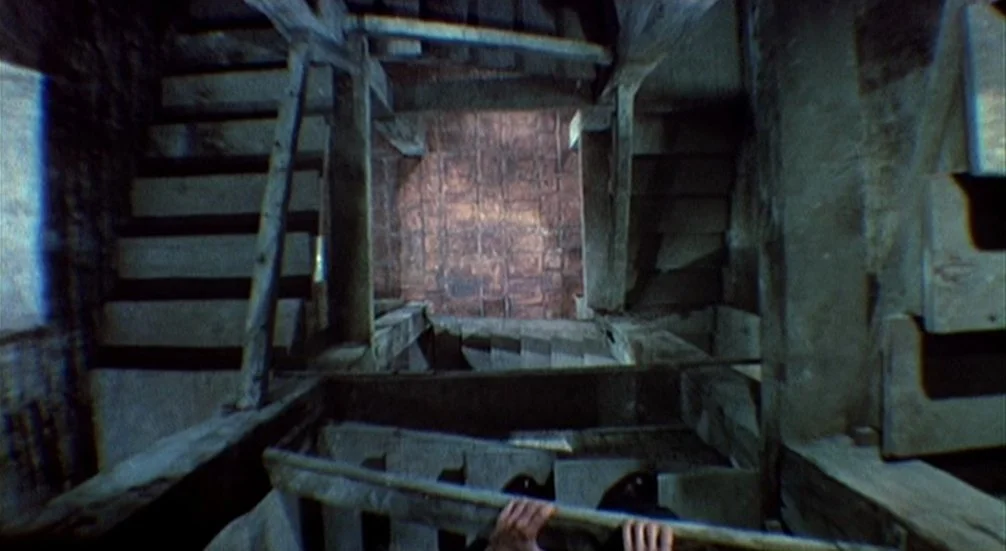
Vertigo features Jimmy Stewart in all of his ‘post-war glory’ as John Ferguson (‘Scottie’ to his friends). He’s a police detective who is unable to continue working after a mistake with his footing sees him almost fall to his death from a rooftop during a chase. His colleague who tries to lend him a hand instead falls to his end. Scottie is now terribly afraid of heights, as elegantly demonstrated by the Vertigo Effect, where the camera shot is in POV, pulling the camera forward or back and zooming in the opposite direction. Otherwise known as a Dolly Zoom.
Scottie’s friend Midge (Barbara Bel Geddes, who later starred in over 300 episodes of Dallas) loves Scottie but they have an awkward tension in their relationship. It has all the makings of a ‘will they, won’t they’ before the film (and Scottie) completely discards her for the beautiful Madeleine Elster (played by Kim Novak).
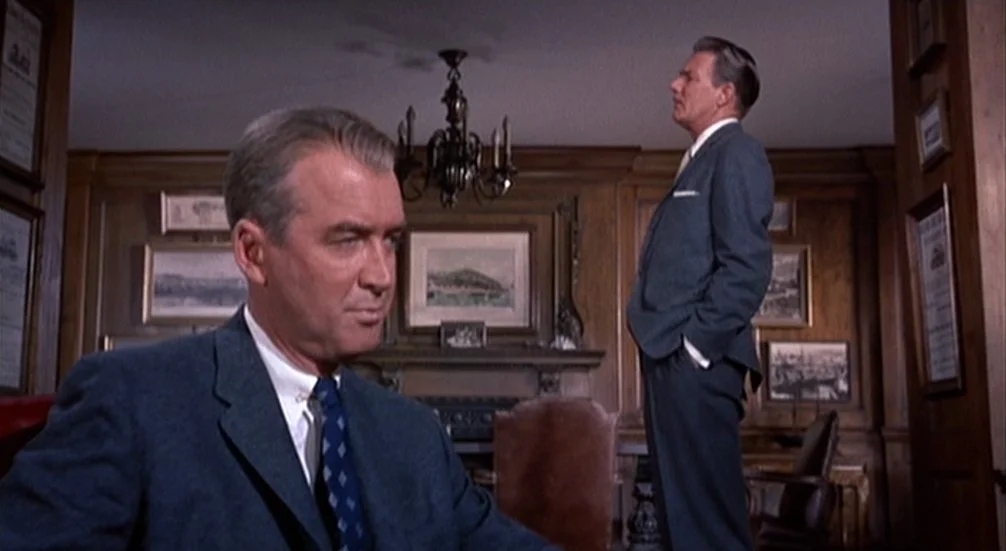
She’s the wife of Scottie’s old college pal Gavin, who is concerned about his wife after she has started to act mysteriously. He fears she may sometimes be possessed. Scottie is available and skilful and an old friend, so Gavin trusts Scottie to tail Madeleine and get to the bottom of it.
© Paramount Pictures
Spoiler Warning
As it turns out, Scottie is not to be trusted, and he starts to fall for Madeleine after he saves her from drowning in the Bay. Scottie is wrestling with his own feelings for Madeleine as well as her apparent obsession with (or possession by) an old dead relative who committed suicide, the tragic Carlotta. When they go together to view a place Madeleine had seen in her dreams, she runs up a bell tower in a trance-like state. Scottie is unable to follow because of his Vertigo, and she launches herself from the bell tower to her death, leaving Scottie to have a mental breakdown.
With Madeleine released from her obsession by her untimely death, now it is Scottie’s time to be obsessed. He looks for Madeleine everywhere, retracing his steps from when he was tailing her; to the restaurant, to the museum. Eventually, he sees Judy, a doppelgänger of Madeleine, and begins a relationship with her, before eventually coercing Judy into dressing exactly like Madeleine. What Scottie doesn’t know (but we do) is that Judy is an actress who played the part of Madeleine so that Gavin could get away with murdering his wife, the real Madeleine.
When Judy foolishly wears some jewellery that belonged to Madeleine, Scottie realised his error and took Judy to the bell tower to confront her. In a tragic twist of circumstance, that honestly comes off as just a little silly, she is scared by a nun and falls to her ironic death, leaving Scottie to have witnessed the woman he thought he loved die twice in the exact same fashion.
“It’s a terrifying insight into a weak man. Us men like to presume that our comparative physical strength advantages over women grants us domain over anything we want to have control over. But control isn’t strength, it’s weakness. ”
Repetition; Vertigo is filled with it. Repeated scenes, repeated motifs. Characters die and are born again, only to die again. Repeat. Repeat. Repeat.
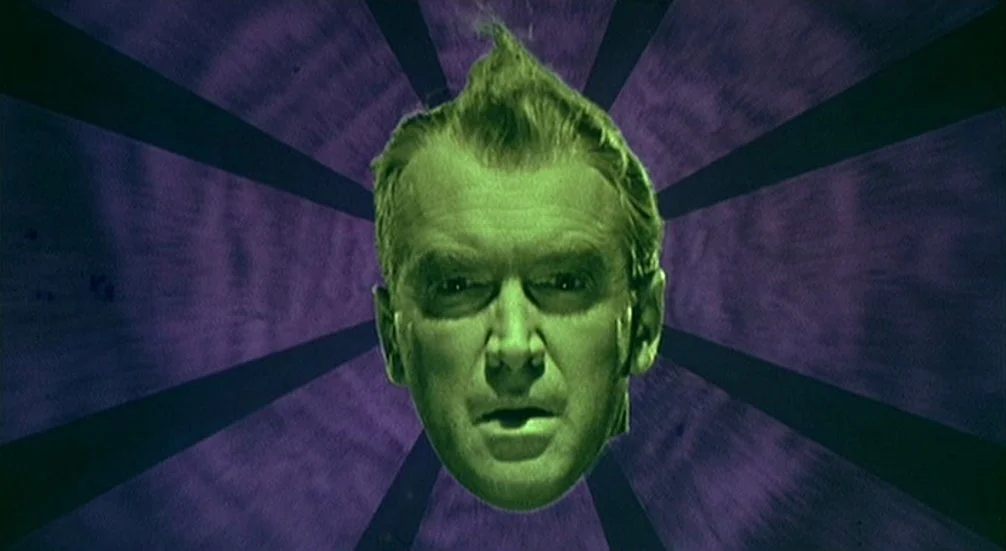
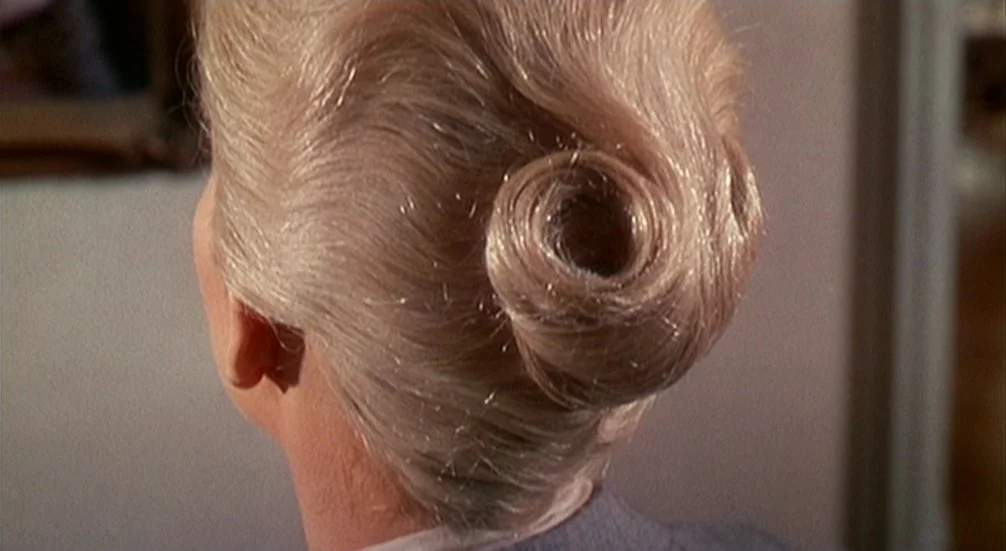
An important symbol in Vertigo is the spiral that we see from the opening credits (put together by the legendary artist Saul Bass). It appears there, it appears during Scottie’s mental breakdown, it appears as he looks down the stairs at the bell tower, it appears in the growth rings of the old tree, it appears in the hairdo of Madeleine (and, of course, Carlotta Valdes). But what is a spiral? It’s a loop. But not just any loop, a loop that features a descent.
As Sean Wilson points out in his book The Sound of Cinema; the Bernard Hermann score applies this motif, even from the opening titles. “In Vertigo, widely considered as Herrmann’s sumptuous masterwork, strings and trombones eddy and spiral to capture the freewheeling madness of James Stewart’s haunted private detective” (page 63).
There it is again, that spiral. Scottie has lost control. He’s lost control of his body when confronted with heights, and he has lost the woman he loved to a circumstance that he didn’t understand. And he couldn’t stop it. Given a do-over, he wasn’t going to lose control again.
© Paramount Pictures
It’s a terrifying insight into a weak man. Us men like to presume that our comparative physical strength advantages over women grants us domain over anything we want to have control over. But control isn’t strength, it’s weakness. Control is what weak men try to do when they don’t have the resilience to stand up to life’s challenges. It’s more than just mitigation, it’s coercing someone you feel superior to, removing their agency and consent, and often times making their life a living hell.
It’s telling that Scottie essentially wants nothing to do with Midge romantically. They have a long-standing friendship, which of course doesn’t necessarily mean romance is assured, but Midge clearly loves Scottie. She’s there for him after his colleague dies. She’s there for him after Madeleine dies and while he’s recovering from his mental break. Importantly, she also challenges Scottie to grow. She’s intelligent and strong-willed. Perhaps not the easiest person to control.
Then along comes Judy. Both versions of her are very easy for Scottie to exert his power over (one is told to fall in love with him as part of an act, the other is guilty from the act she earlier played and the mental toll it took on Scottie). Scottie sees every inch given to him and duly takes a mile. Judy agrees to dress more like Madeleine; Scottie wants to be there to choose the exact right dress. Madeleine reluctantly agrees to go dye her hair blonde, “If I let you change me, will that do it? If I do what you tell me, will you love me?”. “All right then, I’ll do it. I don’t care about me anymore”. Even then, Scottie insists on the spiral curl on the back of her hair.
© Paramount Pictures
We’re told that love is compromise. We’re told that love is sometimes doing something you don’t want to do to make your partner happy. But never like this, or, at least, it shouldn’t be. Anyone that has ever felt this inclination to control any facet of their partner needs to reflect on why that is, and what weakness is causing it (as the author puts his own hand up for sins of the past). Perhaps reflection is what Hitchcock is doing here.
He had a reputation for being a particularly controlling Director, exacting a heavy toll on his actors, particularly the women. A quick look through his filmography and a pattern starts to appear. Blonde, white, slim; he has a type.
Talking to BFI many years later, Kim Novak spoke about her experience of the film. “I think the role appealed to me because it was the resistance of Judy who was, in a sense, me, trying to become the Hollywood person, trying to be Madeleine, needing to be loved and willing to be made over… I remember when I played it, I felt absolutely stripped naked. So vulnerable.” She goes on to say of Hitchcock, “he knew exactly what he wanted”.
A film about obsession by a man who knows exactly what it means to be obsessed makes for an interesting window into the past; providing insight into the behaviour of men in a system that caters to their needs and desires at every turn. The dangers of a man’s obsession is as pertinent in 2026 as it was in 1958, ensuring the legend of Vertigo will continue to survive for some time yet.
Bo Nicholson is a co-founder of Punch & Pie Media. Vertigo is among his favourite films, having first seen it when he was far too young to fully appreciate everything it was doing!