‘Wild Horse Nine’ Review
John Malkovich and Sam Rockwell excel in Martin McDonagh’s typically sly black comedy.
© Searchlight Pictures
Only a Martin McDonagh movie would mix American interventionist foreign policy with chats about dwarves, bombs, cheese, queerness, and Venice. But that’s what we’ve come to expect from the Oscar-winning playwright-turned-filmmaker, and his latest, Wild Horse Nine, does feel a lot like playing the hits. But what hits they are. Bickering buddy duo who share a violent past? Check. Arresting historical location? Snap. The suggestion of redemption and/or damnation hanging over wasted lives? Absolutely. And of course, there’s a fiercely angry boss thrown in there, plus a vituperative dinner confrontation when two snobby people get called a pair of ‘see you next Tuesdays’.
But believe it or not, this isn’t a sequel to McDonagh’s breakout 2008 hit In Bruges, even if it extracts much of the same DNA. The difference between the McDonagh of then and now resides in his steady directorial evolution from mean-spirited charm to emotional generosity, something we’ve also seen in the likes of Three Billboards Outside Ebbing, Missouri and the masterful The Banshees of Inisherin. Certainly, John Malkovich’s ailing CIA agent in Wild Horse Nine is treated far more sympathetically than the assassins of In Bruges, quite a feat when said character appears to have been involved in the assassination of John F. Kennedy.
Still, don’t expect McDonagh to have gone totally soft on us – this is still a filmmaker of quixotic and unpredictable pleasures who delights in split-second swerves between sincerity and jaw-droppingly acerbic comedy. This is where Malkovich proves ideal casting: an actor capable of swinging between high and low with ease, Malkovich has now also attained the kind of craggy visage the camera loves, both gloweringly angry and sweetly sympathetic in equal measure. He is, in short, as unpredictable a presence as the script with which he’s working, something that’s all too often seen him typecast in B-movie nonsense, but for which he’s perfectly suited here.
Malkovich plays Chris, a veteran of the CIA whose long career has seen him deposing governments the world over. His mind going and his body riddled with cancer, Chris is set on writing his memoirs (echoes of Malkovich’s Osbourne Cox from the Coen brothers’ Burn After Reading), to the immense chagrin of his handler MJ (Steve Buscemi), who is increasingly alarmed at the prospect of state secrets being revealed. Come 1973 and now based in Chile, Chris is about to play a key role in the imminent overthrow of the democratically elected President Salvador Allende, although MJ would understandably rather he said nothing.
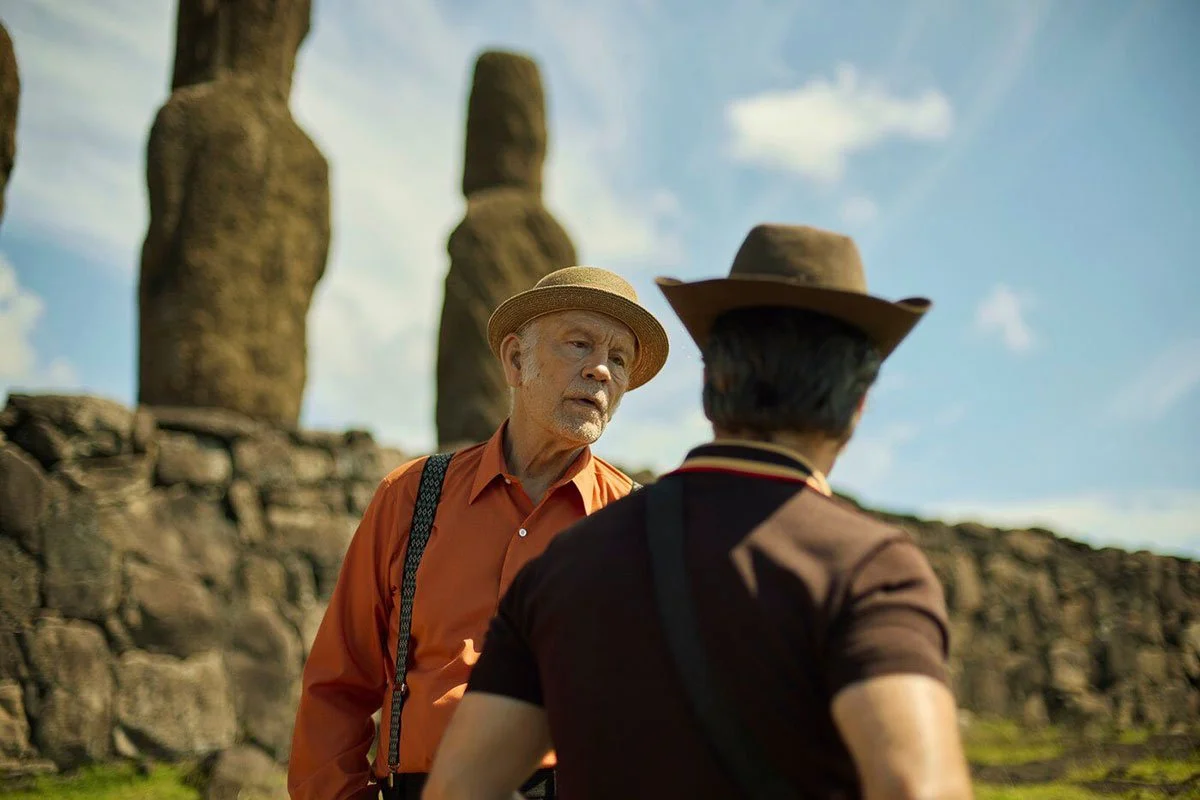
The latter sends Chris and his long-suffering partner Lee (Sam Rockwell) on a vacation to far-flung Easter Island, or to give it its indigenous name Rapa Nui, as they are repeatedly reminded by two young women, Monica and Alicia (Mariana di Girolamo and Ailín Salas) with whom they cross paths. Chris is set on seeing “The big heads” and starting on his reminiscences, even if that involves throwing the reader a curveball by starting the book with a rumination about dinosaurs getting to heaven.
Lee, meanwhile, in a very In Bruges-style plot conceit, is caught between MJ’s need to potentially silence Chris altogether and the desire to stay loyal to his friend. Lee’s shrewish wife Marge (Parker Posey) is found at the other end of the phone in the USA to regularly give him a piece of her mind. The addled, morphine-addicted and increasingly paranoid Chris willingly burbles about everything from his time spent during The Troubles (“I was on the Irish side… For bombs, distract the English with a photo of a dwarf holding a basketball”) while also pining for the time he has left (“She’s life and I’m leaving it,” he tells Lee about Monica in one of the film’s most affecting moments.)
If nothing else, the film is a fine showcase for Malkovich to reclaim cinematic dignity after several years of below-par movies. Chris is a terrific creation and, as usual for McDonagh, he’s also something of a symbol, an isolated, ageing representative of an aggressive, mercurial superpower whose best days are arguably behind it. Chris poignantly finds his surrogates in the Easter Island statues, or ‘moai’, living embodiments of the ravages of time, something that is also made clear when he rings his long-estranged brother, played all too briefly by Tom Waits, in Monument Valley.
That said, the movie doesn’t perhaps integrate its backdrop with its characters as smoothly as The Banshees of Inisherin did: that film was both a buddy farce and a haunting allegory for the Irish Civil War in one. Wild Horse Nine is more bifurcated, drawing its primary joy from allowing Malkovich and the equally excellent Rockwell to shoot the breeze while occasionally stopping, sometimes awkwardly, to acknowledge the CIA’s wider role amid the rubble of modern-day civilisation. And there is emotional sincerity to spare: an especially piercing moment sees Chris unexpectedly warn Monica, superbly played by di Girolamo, about the upcoming Chilean coup in September, compelling her not to return to her home country.
Such moments encapsulate the best of McDonagh in a nutshell: it’s deeply serious and utterly absurd at the same time. Handsomely lensed by Ben Davis, who never misses the opportunity for a panoramic glide across the majestic “big heads”, and scored with a mix of needle drops and a discreet accompaniment by Carter Burwell, the film is as aesthetically pleasing as anything in McDonagh’s canon, even if the substance comes up short. But when the incidental convos are this much fun, who cares?
Rating: 4/5
Sean Wilson is a Film Critic based in Bristol, UK. If you enjoyed his review, please consider supporting him by subscribing to his substack or by purchasing his book The Sound of Cinema