‘Elsinore’ Review
Andrew Scott is outstanding in a rousing biopic that excavates warmth from tragedy.
© StudioCanal
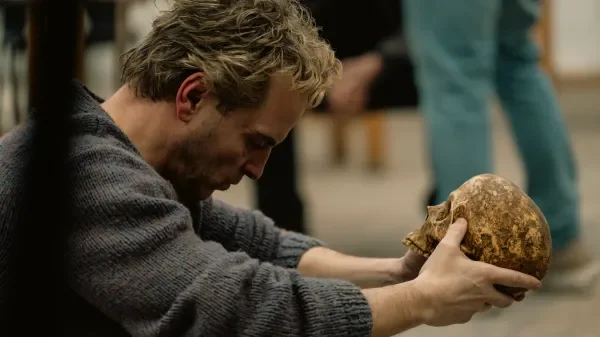
“To thine own self be true,” wrote William Shakespeare in his enduring masterpiece Hamlet, a heaven-born philosophy that also underscored the life of Scottish actor Ian Charleson. Propelled into global stardom via his role in 1981’s Oscar-winning Chariots of Fire, Charleson always felt his true calling was on the stage, and before his life was tragically cut short by complications from AIDS in 1990, Charleson delivered what is considered by most to be a definitive portrayal of the Prince of Denmark at London’s National Theatre. It was, and remains, a spectacular, late-blooming triumph from a performer who was poised to do much more, and it serves as the backdrop of the new drama Elsinore, with Andrew Scott now taking on the role of Charleson.
The movie, directed by theatre veteran Simon Stone and scripted by Pride’s Stephen Beresford, is an appreciably honest snapshot of mid-1980s British queer culture, one that was being hollowed out by HIV and AIDS to the tune of hundreds of deaths a day. Charleson has already portrayed Hamlet once, to less than satisfactory results, and is hounded by the spectre of Chariots of Fire and its Oscar-winning Vangelis theme music, to genuinely amusing effect. It’s the first sign of the film’s brimming humanity, utilising humour to punctuate and illuminate a real-life struggle without ever undermining it.
Having pursued Hollywood, Charleson wants to tread the boards again but is surrounded by ghosts, including recently AIDS-diagnosed friend Georgie (played by Bridgerton’s Luke Thompson) and the embittered yet pioneering queer artist Derek Jarman (David Dawson), whom Charleson is said to have jilted in favour of a movie career. Charleson’s own diagnosis with AIDS aligns with providence: Daniel Day-Lewis (largely unseen) has just stormed off stage mid-performance in Richard Eyre’s National Theatre performance of Hamlet, something that’s well played for bemused, but never mean-spirited, laughs, and the latter requests Charleson as a replacement. It’s unclear if the actor’s health diagnosis will disrupt the run and Eyre is understandably hesitant, but Charleson insists that it is his choice to proceed, something he has to do.
The movie efficiently intercuts the National Theatre rehearsals and eventual performance with the harsh realities of Charleson’s declining health. The lynchpin is his burgeoning friendship with Doctor Margaret Johnson (Olivia Colman), who has seen so many men lost to AIDS and is deeply suspect of Charleson’s dedication to the Hamlet performance. Is there a kind of nobility in death, especially when taking on the greatest of all roles? Johnson is doubtful, but Charleson remains steadfast, setting up plenty of chalk and cheese humour to offset the sadness. “No more talk about death,” she instructs. Not missing a beat, Charleson replies, “That’ll be hard to do, it’s one of the key themes of the play.”
Indeed, it may surprise many to note how funny Elsinore is, a refreshing approach in a sub-genre that so often gives way to maudlin sentimentality. Rather than being defined by the sadness of Charleson’s death, the movie is instead palpably imbued with his pulsating sense of life. The editing is brisk and energetic, especially during the Hamlet staging scenes, and Beresford’s sharp script delivers throughout. “Christ, you’re even cruising in an AIDS clinic,” Charleson tells his friend when another patient, played by Heartstopper’s Joe Locke, appears to be making eyes at him.
Scott is typically terrific in the role, assaying a Charleson who is vivacious, intellectually curious and endlessly witty. Crucially, he also refuses to be brought low by his own mortality and, by taking on the formidable role of Hamlet, finds an analogy for his own circumstances. His scenes with Colman are especially effective, blurring the lines between pragmatism and passion as he informs the skeptical doctor that acting isn’t about extending a life but seizing a moment of capricious emotion. It would feel somewhat on the nose were it not for the fact it’s based on true events – truth really is stranger, and far more inspiring, than fiction. Colman more than does justice to Johnson, a key figure who eventually opened the Ian Charleson Day Centre to offer pioneering clinical trials that helped turn the tide against the virus.
Although it’s appreciably good-natured throughout, the movie never trivialises the scenario. Brief but impactful appearances from Peter Mullan and Georgie Glen as Charleson’s shell-shocked parents provide some of the movie’s most devastating moments, and the scene in which Charleson finally admits his diagnosis to the rest of the Hamlet cast encapsulates a powerful sense of understated community spirit, not least from Johnny Flynn’s sympathetic Eyre and Juliet Stevenson’s maternal Sylvia Syms. Great roles abound from Billie Piper’s casting director confidante Patsy Pollock to Monica Dolan’s dry stage door manager who is never one to let Charleson wallow.
The movie pulls off several coups. It’s a rousing tribute to the power of the spoken word, an ode to a recent period in history where the emotional wounds continue to suppurate, and, above all, a testament to a remarkably brave man. The finale is undeniably overwrought and manipulative, but forgivable in the light of such circumstances. It is an operatic edifice to a hard-fought life, well-lived.
Rating: 4/5
Sean Wilson is a Film Critic based in Bristol, UK. If you enjoyed his review, please consider supporting him by subscribing to his substack or by purchasing his book The Sound of Cinema