The latest from stop-motion maestros LAIKA Studios is a visually arresting fantasy epic.
© LAIKA Studios
Despite being based in the very real city of Portland, Oregon, stop-motion studio Laika has had a hardline to our dreams and psyches for the best part of 20 years now. From the demonic button-eyed parents of Coraline to the loving George A. Romero riffs in ParaNorman and the Shinto/Buddhist-inflected Kubo and the Two Strings, Laika, at its best, balances surrealistic substance with an underlying sense of sweetness and redemption. Even their smaller, somewhat underrated works like The Boxtrolls and Missing Link take great delight in viewing human connection through a skewed lens.
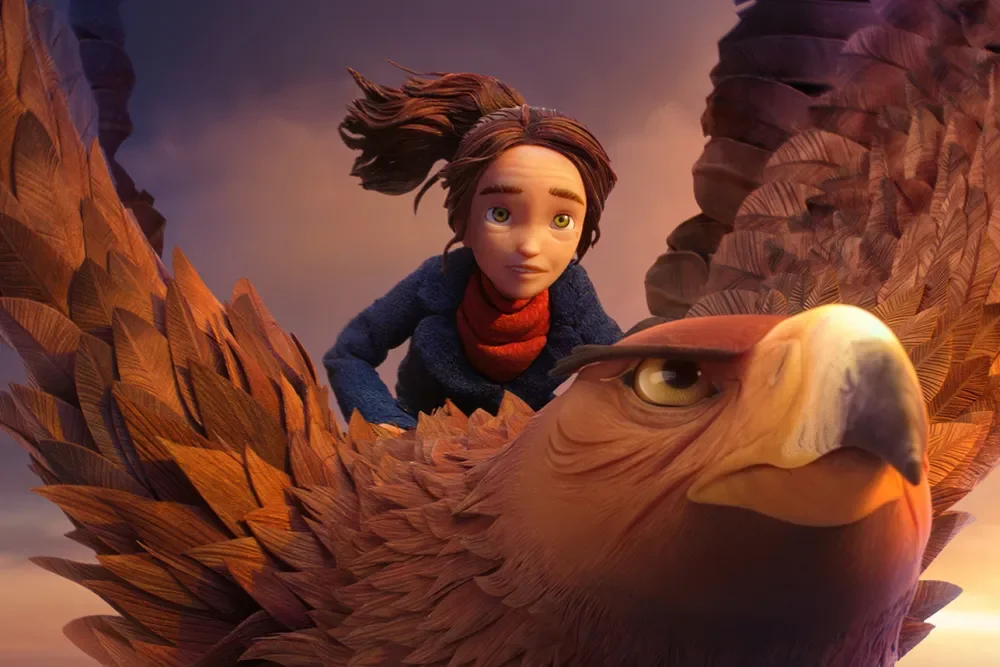
Those principles are very much at work in the studio’s latest project, Wildwood, and it’s easily their most ambitious so far. If you don’t believe that, just check out the production history: principal photography alone has taken five years to complete, a quarter of the time that Laika has been in existence. Not just a new movie, the film is being pitched as an evolutionary upgrade of the stop-motion principles seen in the likes of The Nightmare Before Christmas and the classic works of Aardman. It’s hard to deny the results on a technical level: rippling, soaring and palpably rustling textures abound on both a big and small scale, quite unlike anything seen in a stop-motion movie before. Even the skin textures of the human characters have a fleshy fluidity that gorgeously blurs the line between fantasy and verisimilitude.
Laika head honcho and regular director Travis Knight, along with screenwriter Chris Butler, adapts the book of the same name, the first in the series by Colin Meloy and Carson Ellis. The narrative splits the difference between a nicely satirical view of Portland itself (cue the cos-playing, flamethrower-wielding Darth Vader on a bike) and the so-called ‘Impassable Wilderness’ of trees that exists across the bridge. Our hero is pre-teen Prue McKeel (voiced by Peyton Elizabeth Lee) who is the child of two loving, hippyish parents (voiced by Jake Johnson and Maya Erskine); Prue has an infant brother, Mac, and is doted on by dorky classmate Curtis (Jacob Tremblay). Not heeding her parents’ warnings to keep Mac indoors, and perhaps dimly aware of some mysterious genetic ancestry that she cannot identify, Prue takes Mac to the park where he is promptly kidnapped by a flock (make that, as Curtis reminds her, a ‘murder’) of crows and taken into the wilderness.
In hot pursuit, and piercing the veil between the two worlds by enigmatic magic, Prue and Curtis discover an extraordinary forest landscape that crosses anthropomorphic animals with tribal humans, avian clans with coyote redcoats. Prue’s brother has been snatched at the behest of the imperious, dangerous and yet sympathetic Dowager Countess Alexandra (excellently voiced by Carey Mulligan), who, owing to a tragedy that we see in the film’s striking cold open, is intent on using Mac to reinstate what she has lost. The exiled Alexandra commands the fearsome coyotes and has the rest of the forest living in fear; this includes the Avian Principality, presided over by the great golden eagle the General (Angela Bassett, superb), the Mystics and the bandits, who are led by their own King (Mahershala Ali).
The stage is very much set for a conflict of Tolkien and Lewis-aping proportions, and the scale with which it’s depicted is truly breathtaking. From out of nothing, Knight and his animators have actively populated a world of dense mythology and overlapping characters, some good, some evil, and some who are intriguing shades of in-between. Richard E. Grant voices the wise Owl Rex, who is our de facto expositor; Awkwafina brings much-needed levity as the loyal rat Septima who bonds with Curtis; Tom Waits is vicious and scary as the lead coyote redcoat; and Tantoo Cardinal brings palpable warmth to the old mystic seer Iphigenia with whom Prue ultimately joins forces. The tactility of the character creations and the world they occupy is remarkable, with auburn light breaking over a sea of vermilion trees and also sparkling within the eyes of characters both human and non-human. There’s no denying it’s a huge step forward for stop-motion as a whole.
The problem is that the fluidity of the characters and the accompanying camera movements is often so slick, particularly during the flying sequences, that we may as well be watching something rendered via CGI. Those who appreciated the viscerally janky and quirky movements of Jack Skellington, for instance, may find themselves pining for something cruder yet imbued with more tactile and charming qualities. It’s an upgrade in technique, but perhaps a downgrade in our emotional investment: it often feels like a stop motion movie that lacks the proverbial Aardman thumbprint or a tactile sense of soul that lifts a given movie beyond mechanics into something enchanting. It’s telling that the film’s best moments are when it slows down and gets into the faces of the characters to observe their soul, the haughty Alexandra being an especially interesting mixture of froideur, villainy and deep-seated sadness. Mulligan conveys Alexandra’s sense of manipulation with audible glee.
Whereas the animation is a step up, the narrative lacks the confidence and the mystique we’ve come to expect from the best Laika movies. Character motivations and backgrounds are relayed in narrative-interrupting chunks of exposition from external perspectives, which also, in the case of Alexandra, threatens to rob them of their agency. In the studio’s earlier films, there was clear confidence in pictures speaking a thousand words: the ‘other mother’ in Coraline, for instance, was the ultimate symbol of every child’s nightmare even before she opened her mouth, whereas in Wildwood they are constantly saying what they’re thinking and feeling. There’s an abundance of overly on-the-nose dialogue from the off, particularly with regards to Prue’s destiny (“You think you outgrew magic, but magic didn’t outgrow you”) and a sense that, for once, Laika is struggling to identify its audience. Cartoonish slapstick and musical needle drops, including one from The Decemberists, to whom author Colin Meloy belongs, are offset with commendably brutal moments that may startle and frighten the youngest of kids. (The film is rated 12A in the UK for a reason.) There’s also an odd instance of a key character who’s killed off and never mentioned again, which makes their sacrifice and symbolism feel arbitrary in the grand scheme of things.
The film is ultimately a hodgepodge fetch quest narrative that, for all its gesticulating at grand fantasy, isn’t imbued with the emotional wonder or intimacy of Laika’s best work. In addition to Lord of the Rings and Narnia, there’s a clear nod to Avatar with the presence of a sentient tree, Princess Monokoke in the tribal forest setting, more than a touch of How to Train Your Dragon when the film takes to the skies, and even a touch of Disney’s Zootopia in a comical scene of animal bureaucracy. What we don’t get is a genuine sense of mysticism connecting all of the disparate set-pieces together, although the movie rallies itself for a truly spectacular finale unlike anything seen within a stop-motion world before. One particular climactic set-piece is surely set to fuel behind-the-scenes exposes for years to come – the layering of perspectives, conflicts and movements musters both a sense of filmmaking ambition and emotional investment to end on a high. For that one sequence alone, Wildwood validates itself as an awe-inspiring time at the cinema and in all likelihood epitomises a watershed moment for the stop-motion medium: a link between this world and what comes next.
Rating: 4/5
Sean Wilson is a Film Critic based in Bristol, UK. If you enjoyed his review, please consider supporting him by subscribing to his substack or by purchasing his book The Sound of Cinema