Jeanne Dielman, 23 quai du Commerce, 1080 Bruxelles: The greatest film ever?
To begin our new series re-evaluating the Sight and Sound Poll, what better place to start than the film anointed the greatest of all time?
The Sight and Sound Top 100 is the definitive film list. The IMDB Top 250 probably has more familiarity with the average film fan, but there is something special that happens every year that ends in 2, when Sight and Sound magazine canvasses the opinion of hundreds of critics around the world (and Directors for a separate poll), and crowns the greatest films of all-time.
First held in 1952, The Bicycle Thieves was anointed the greatest film ever. By the time the next poll occurred in 1962, Citizen Kane took first place. The following 4 polls (1972, 1982, 1992 & 2002) had much jostling throughout the top 10 and the broader top 100, but one constant remained; Citizen Kane was the greatest film of all time. That is, until the 2012 poll saw Vertigo dethrone Kane to become the owner of top spot.
Heading into late 2022, film fans around the world became impatient waiting for the results of the scheduled poll. To pass the time, people started trying to guess what number 1 would be. Would Hitchcock’s Vertigo retain its place at the top of the mountain, or would Kane stage a comeback and once again become number 1. If not either of those, surely it would be something from the accepted pantheon of films; Ozu’s Tokyo Story, Renoir’s La Regle du jeu and Kubrick’s 2001: A Space Odyssey all featured in the previous Top 10 in 2012, perhaps they could ascend? You’d be a brave person to rule out The Godfather or Seven Samurai.
The list dropped. Number 1; Jeanne Dielman, 23 quai du Commerce, 1080 Bruxelles.
“I’ve heard of that, but I can’t even pronounce it” said a bunch of us pathetic English-speakers who are utterly atrocious at other languages. It’s ok, I’ll wear the shoe if it fits. The bigger problem for me was that this was announced as the greatest film ever, I’m a huge film fan, and I’ve never seen it.
Thus began a surprisingly difficult task of legally (and affordably) seeing the film in Australia; perhaps a sign of how surprising the win was, even to DVD stores supposed to be stocking it.
“There’s no doubting it’s a masterpiece of slow cinema and a key feminist text in the medium of film. But is it the greatest film ever?”
Jeanne Dielman made its first appearance in the Sight and Sound Top 100 in 2002, surging into equal 36th in 2012. Its position in the annals of cinema was becoming more assured as more people became inspired by its feminist themes and patient, precise technique. Clocking in at over 3 hours, it’s the longest film to top the poll. More importantly, it’s the first directed by a woman.
Director Chantal Akerman was born in Brussels and grew up in Belgium. Born in 1950, her Jewish parents survived the Holocaust. Specifically, her mother survived Auschwitz. Inspired by the films of the French New Wave, especially Pierrot le fou, Chantal knew she wanted to be a filmmaker. Her mother famously didn’t want her to just settle down and marry a man, as was the standard thing for a young woman to aspire to according to societal conventions. Chantal briefly went to film school in Brussels, before dropping out to make a short film, then moved to New York and then back to Belgium to launch her film career. A few years later, she made Jeanne Dielman.
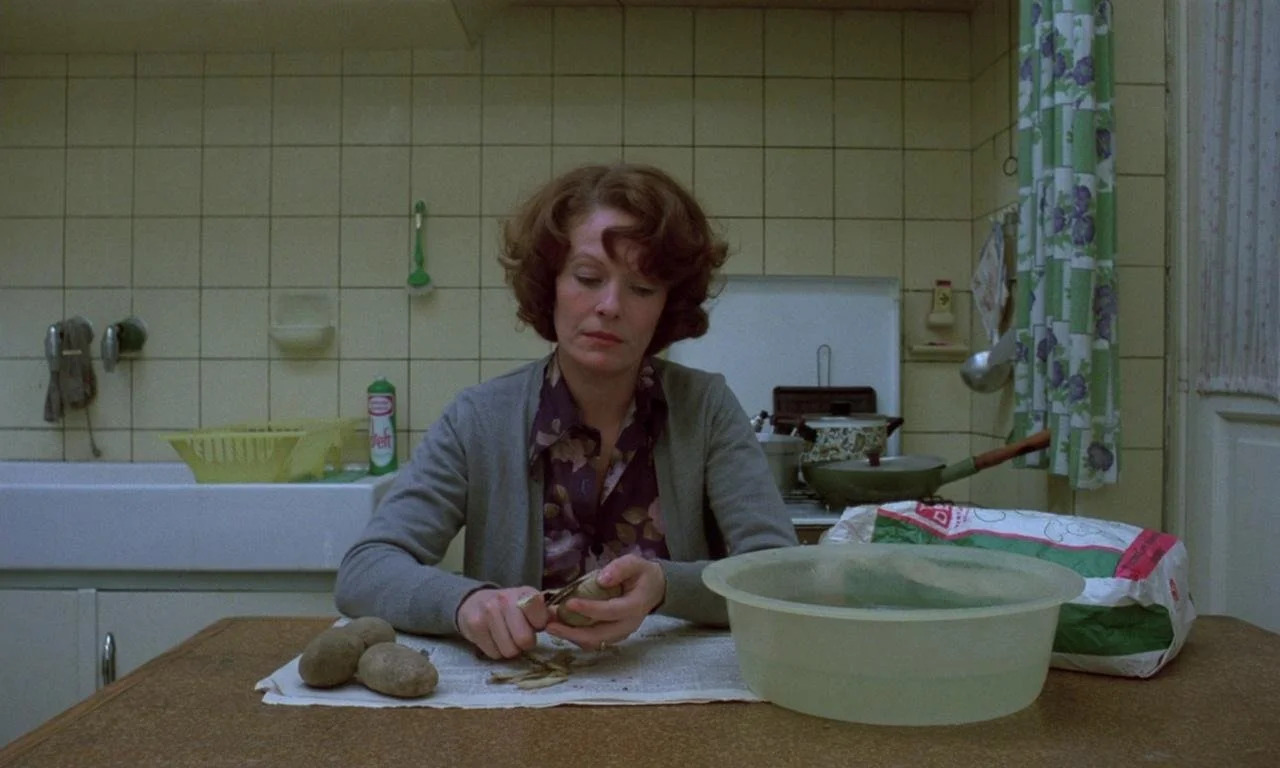
The film’s title is the name and address of its central character. Jeanne is a middle-aged widow, raising her teenage son in their apartment. She cooks, she cleans, she goes shopping for bits and bobs and groceries. She’s friendly with the local store managers. And she engages in sex work to make ends meet, with regular clients coming to her apartment while her son is at school.
Jeanne’s life is about order and control. Her routine is down to the minute. Her apron is pristine, as is her hair and the rest of her outfit. She turns the light on as she enters the room and off as she leaves it. Her movements are precise. Her interactions with her son are cold. Beneath Jeanne’s control of her environment is a seething; a pulsing regret at what her life is and what it could have been.
It’s a film that observes that a woman’s stated place is the household, and how utterly wrong that feels. It’s a film where an out of place hair on Jeanne’s head or an undone button on her blouse has the emotional impact of a character dying in a lesser film. Jeanne starts to prowl the apartment like an animal in a cage, entering rooms she didn’t need to go into, forgetting to turn lights off as she leaves them in confusion and frustration. Who is this person? This isn’t the Jeanne that I’ve come to know. And you do feel like you know her, the glacial pacing and exhaustive runtime achieving the desired reaction at what ultimately, perhaps inevitably, transpires.
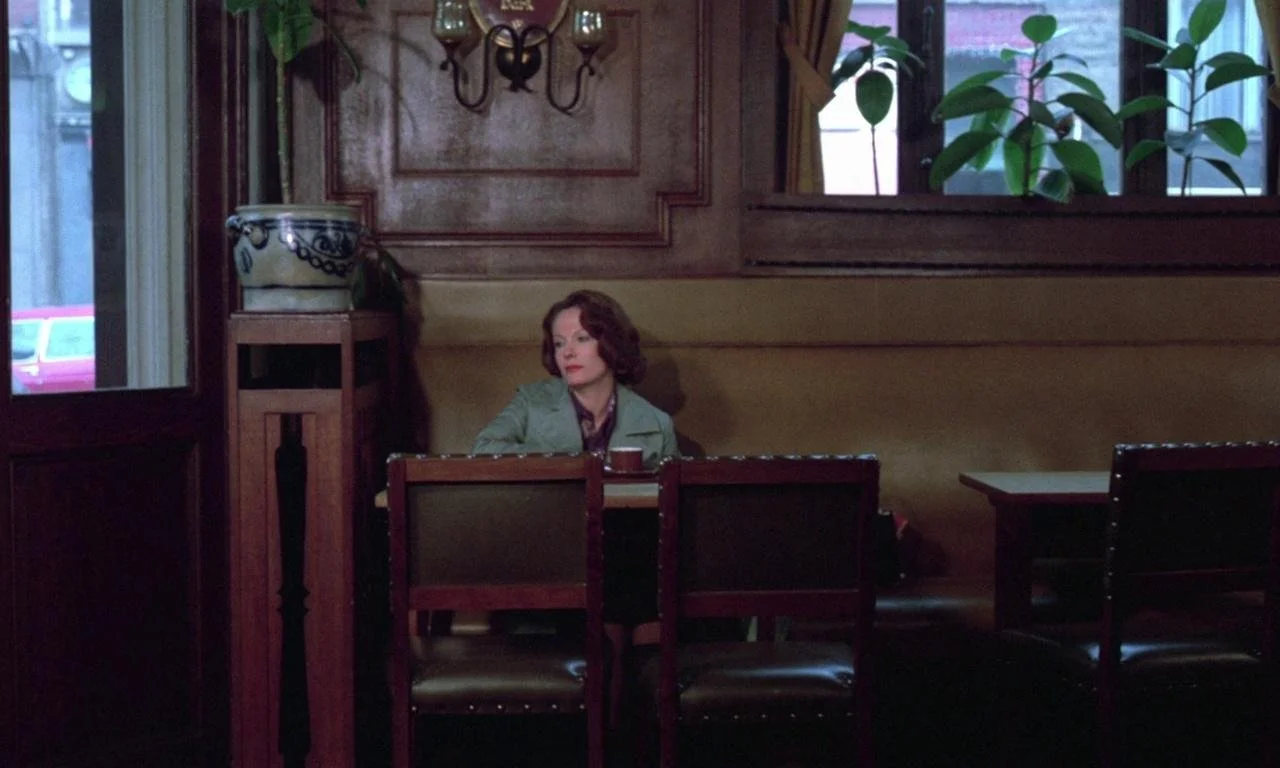
There’s no doubting it’s a masterpiece of slow cinema and a key feminist text in the medium of film. But is it the greatest film ever?
In this author’s opinion, maybe not. Heavy is the head that wears the crown, and the critics polled who voted in such an impressive number that this film won outright first place have put a target on this film that it may not be able to stand up to with many viewers. The Greatest Film Ever? Can any film really wear that crown?
There’s probably a larger conversation here about whether it’s possible to call any film the greatest ever, and I’m happy to have it another time.
As surprising as it was when it was announced, Jeanne Dielman is not an absurd choice for the number 1 spot. It may seem egregious to those that haven’t seen it, but to them I’d suggest setting aside 3 and a half hours (it’s best enjoyed in one sitting) and getting to know Jeanne’s life through the still and patient lens of Chantal Akerman. Whether it’s the greatest film ever is irrelevant, we’re all better for films like this existing.
Bo Nicholson is a co-founder at Punch & Pie Media and a self-confessed nerd for film lists. There’ll be more evidence of this coming soon.